History of the spa town
Two thousand years of history!
Thermal water bubbles up from 18 different sources in Baden. The Romans attributed healing properties to the 47°C water and established the settlement of 'Aquae Helveticae' at the Limmatknie. What they did not realise at the time was that Baden's thermal water is the most mineral-rich in Switzerland. The rest is history.
Roman times
Bathing was of great social importance in ancient Roman times. It was the Roman legionaries stationed at the legionary camp in Vindonissa, around seven kilometres away, who first discovered the warm springs in the Limmatknie. These springs were believed to have healing properties.
What the Romans did not know at the time was that the thermal water in Baden is not only one of the warmest in Switzerland at around 47°C, but also the most mineral-rich at 4.6 grams per litre. Rising naturally to the surface from depths of up to 1,200 metres through 18 springs, the water provides a pleasant warmth. Its uniquely high mineralisation is achieved through 4,000 to 12,000 years of storage in the rock beneath the spa town. As well as containing calcium, iron and iodine, the 'liquid gold' also contains sulphur. It is this mineral that gives the thermal water its distinctive smell. Other ingredients include methane, fluorine, zinc and magnesium. Magnesium is essential for muscle function and bone formation in the human body.
The first large thermal baths were built by Roman legionaries in the second decade AD. This laid the foundation for the Aquae Helveticae spa. The Aquae baths were the most important Roman spa in present-day Switzerland. They were used not only for medical treatment, but also as a religious centre and an important social meeting place. A small settlement with residential buildings and craft workshops developed around the baths. The Helvetii, the Habsburgs and the Swiss Confederates all benefited from Baden's thermal waters and shaped the bathing culture.
Middle Ages
Even after the end of Roman rule around 400 AD, people continued to bathe in the Limmatknie, although little is known about the baths in the following centuries.
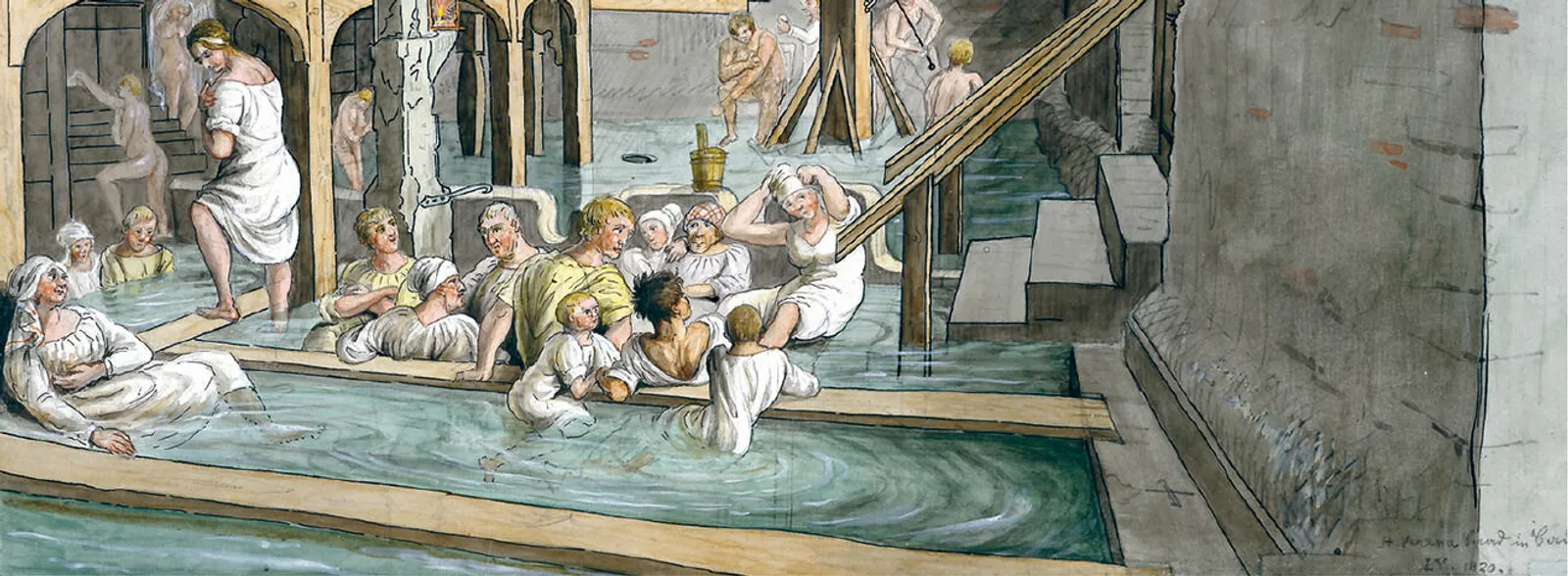
Around 1100, evidence of major construction work on the baths re-emerges, linked to an expansion in bathing activities. From the mid-13th and 14th centuries onwards, under the Dukes of Habsburg, the spa resort became the most famous bathing resort in German-speaking Europe. Crowned heads, church leaders, polymaths and the urban bourgeoisie from Zurich met in the inns and guesthouses on both sides of the Limmat to bathe together. The general population, including the poor and sick, had access to open-air bathing facilities at the Freibad and St. Verena Bad on Bäderplatz, as well as at the Freibad in the Kleine Bäder in Ennetbaden. From the 15th century onwards, the Federal Council envoys, who regularly gathered in Baden, enjoyed the baths as a pleasant 'leisure activity' and informal meeting place. The baths' small-town appearance today is characterised by buildings dating back to their heyday in the Middle Ages and early modern times.
19th to 21st century
During the spa and health resort boom of the 19th century, the baths experienced a revival: new thermal springs were discovered and modern hotels were built. The opening of Switzerland's first railway line, the Spanischbrödlibahn, which ran from Zurich to Baden, brought further prosperity to the baths. The construction of the Kursaal (now the Grand Casino) and the spa gardens also gave the spa resort a contemporary infrastructure. By around 1880, almost 900 guest rooms and over 600 individual baths were available to spa guests from all over the world, while less affluent guests received medical care in the spa clinics.
The First World War brought an abrupt end to the glamorous spa business of the Belle Époque.
The writer Hermann Hesse immortalised the interwar period spa business in his novella Kurgast (The Spa Guest). Following the Second World War, Baden increasingly focused on medical services and rehabilitation.
Towards the end of the 20th century, the baths were in crisis. The infrastructure, particularly the thermal baths built in 1963/64, could no longer meet the needs of guests. Since the turn of the millennium, however, the baths have been gradually revived. The unique thermal springs are set to become a meeting place once again, as they were in the past. The groundbreaking ceremony for Mario Botta's new thermal baths in April 2018 marked the beginning of this revival. In collaboration with the Bad Zurzach and Baden Health Promotion Foundation and other partners, the city of Baden has established a forward-looking vision for the baths in terms of health, work, leisure and living.
Alongside the construction of the new public thermal baths designed by renowned architect Mario Botta, a medical centre and residential building have also been constructed. The public spaces have also been upgraded: the redesigned Kurplatz and Mättelipark, as well as the spacious Limmat promenade, now invite visitors to linger.
With their long history and buildings dating back 2,000 years, the Baden baths represent a unique ensemble of great cultural and historical significance in Europe. The healing waters, unique scenic location in the Limmat Valley, and spa area characterised by numerous historic buildings offer visitors a special experience and the chance to become part of this great history.
You can discover further exciting details and interesting facts about Baden's baths on a guided tour of the city.